Discovery of Goethe’s amber ant: its phylogenetic and evolutionary implications
| Museum collections remain essential scientific resources, especially when revisited using modern analytical techniques. In an interdisciplinary study, we examined the overlooked amber collection of Johann Wolfgang von Goethe (1749–1832), polymath and pioneer of art and natural science. Using synchrotron-based micro-computed tomography (SR-µ-CT), we identified a fossil ant from Baltic amber (Eocene ~ 47–34 Ma) in Goethe’s collections. The specimen is assigned to †Ctenobethylus goepperti (Mayr in Die Ameisen des Baltischen Bernsteins. Beiträge zur Naturkunde Preussens, 1868), which we redescribe and re-diagnose, proposing †Eldermyrmex exsectus Dubovikoff et Dlussky, 2019 as its junior synonym (syn. nov., comb. nov.). We further infer a potential sister-group relationship with the extant genus Liometopum Mayr, 1861, suggesting that †C. goepperti may have been a dominant arboreal species in warm-temperate coniferous forests, a scenario which is supported by its abundance in Baltic amber. Critically, our results document endoskeletal structures in a Cenozoic fossil ant, underscoring both the morphological value of historical collections and the lasting scientific legacy of Goethe’s naturalist vision. Brendon E. Boudinot et al. | 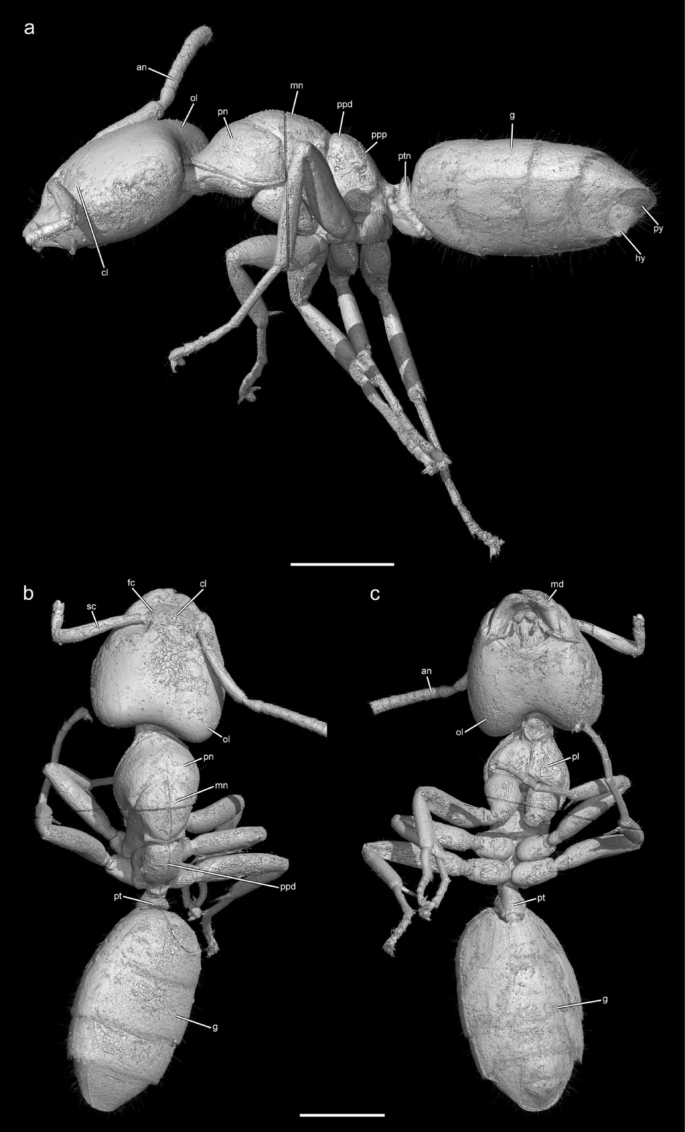 |