Skip to content

science

Interactive analysis notebooks on DESY batch resources

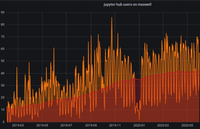
Batch scheduling systems are usually designed to maximise fair resource utilisation and efficiency, but are less well designed for demanding interactive processing, which requires fast access to resources while low upstart latency is only of secondary significance for high throughput of high performance computing scheduling systems. The computing clusters at DESY are intended as batch systems for end users to run massive analysis and simulation jobs enabling fast turnaround systems, in particular when processing is expected to feed back to operation of instruments in near real-time. The continuously increasing popularity of Jupyter Notebooks for interactive and online processing made an integration of this technology into the DESY batch systems indispensable. We present here our approach to utilise the HTCondor and SLURM backends to integrate Jupyter Notebook servers and the techniques involved to provide fast access. The chosen approach offers a smooth user experience allowing users to customize resource allocation tailored to their computational requirements. In addition, we outline the differences between the HPC and the HTC implementations and give an overview of the experience of running Jupyter Notebook services.

Comput Softw Big Sci 5, 16 (2021).

Pump-probe X-ray holographic imaging of laser-induced cavitation bubbles with femtosecond FEL pulses

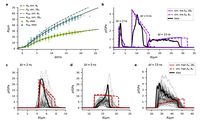
Cavitation bubbles can be seeded from a plasma following optical breakdown, by focusing an intense laser in water. The fast dynamics are associated with extreme states of gas and liquid, especially in the nascent state. This offers a unique setting to probe water and water vapor far-from equilibrium. However, current optical techniques cannot quantify these early states due to contrast and resolution limitations. X-ray holography with single X-ray free-electron laser pulses has now enabled a quasi-instantaneous high resolution structural probe with contrast proportional to the electron density of the object. In this work, we demonstrate cone-beam holographic flash imaging of laser-induced cavitation bubbles in water with nanofocused X-ray free-electron laser pulses. We quantify the spatial and temporal pressure distribution of the shockwave surrounding the expanding cavitation bubble at time delays shortly after seeding and compare the results to numerical simulations.

Vassholz, M., Hoeppe, H.P., Hagemann, J. et al.

Nat Commun 12, 3468 (2021).

Structure and dynamics of a mycobacterial type VII secretion system

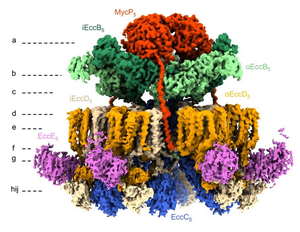
Mycobacterium tuberculosis is the cause of one of the most important infectious diseases in humans, which leads to 1.4 million deaths every year(1). Specialized protein transport systems-known as type VII secretion systems (T7SSs)-are central to the virulence of this pathogen, and are also crucial for nutrient and metabolite transport across the mycobacterial cell envelope(2,3). Here we present the structure of an intact T7SS inner-membrane complex of M. tuberculosis. We show how the 2.32-MDa ESX-5 assembly, which contains 165 transmembrane helices, is restructured and stabilized as a trimer of dimers by the MycP(5) protease. A trimer of MycP(5) caps a central periplasmic dome-like chamber that is formed by three EccB(5) dimers, with the proteolytic sites of MycP(5) facing towards the cavity. This chamber suggests a central secretion and processing conduit. Complexes without MycP(5) show disruption of the EccB(5) periplasmic assembly and increased flexibility, which highlights the importance of MycP(5) for complex integrity. Beneath the EccB(5)-MycP(5) chamber, dimers of the EccC(5) ATPase assemble into three bundles of four transmembrane helices each, which together seal the potential central secretion channel. Individual cytoplasmic EccC(5) domains adopt two distinctive conformations that probably reflect different secretion states. Our work suggests a previously undescribed mechanism of protein transport and provides a structural scaffold to aid in the development of drugs against this major human pathogen.

Nature volume 593, pages 445–448 (2021)

Bunduc, CM, Fahrenkamp, D, Wald, J, Ummels, R, Bitter, W, Houben, ENG, Marlovits, TC

Upscaling of multi-beam x-ray ptychography for efficient x-ray microscopy with high resolution and large field of view

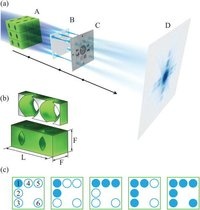
Nondestructive imaging with both a large field of view and a high spatial resolution is crucial to understand complex materials and processes in science and technology. X-ray ptychography can provide highest spatial resolution but is limited in the field of view by the acquisition time and coherent flux at modern x-ray sources. By multi-beam ptychography, the sample can be imaged in parallel by several spatially separated and mutually incoherent beams. We have implemented this method using 3D nanoprinted x-ray optics to create tailor-made x-ray multi-beam arrays. The use of 3D printing allows us to create focusing optics with a minimum of nonfunctional support structures. In this way, large sample areas can be efficiently scanned in parallel with up to six illuminating beams.

Applied Physics Letters, https://doi.org/10.1063/5.0045571

Felix Wittwer, Mikhail Lyubomirskiy, Frieder Koch, Maik Kahnt, Martin Seyrich, Jan Garrevoet, Christian David, and Christian G. Schroer


Substrate-engaged type III secretion system structures reveal gating mechanism for unfolded protein translocation

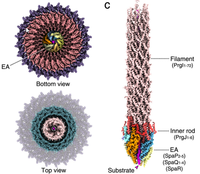
Many bacterial pathogens rely on virulent type III secretion systems (T3SSs) or injectisomes to translocate effector proteins in order to establish infection. The central component of the injectisome is the needle complex which assembles a continuous conduit crossing the bacterial envelope and the host cell membrane to mediate effector protein translocation. However, the molecular principles underlying type III secretion remain elusive. Here, we report a structure of an active Salmonella enterica serovar Typhimurium needle complex engaged with the effector protein SptP in two functional states, revealing the complete 800Å-long secretion conduit and unraveling the critical role of the export apparatus (EA) subcomplex in type III secretion. Unfolded substrates enter the EA through a hydrophilic constriction formed by SpaQ proteins, which enables side chain-independent substrate transport. Above, a methionine gasket formed by SpaP proteins functions as a gate that dilates to accommodate substrates while preventing leaky pore formation. Following gate penetration, a moveable SpaR loop first folds up to then support substrate transport. Together, these findings establish the molecular basis for substrate translocation through T3SSs and improve our understanding of bacterial pathogenicity and motility.

Nat Commun 12, 1546 (2021). https://doi.org/10.1038/s41467-021-21143-1

Miletic, S., Fahrenkamp, D., Goessweiner-Mohr, N. et al


X-ray screening identifies active site and allosteric inhibitors of SARS-CoV-2 main protease

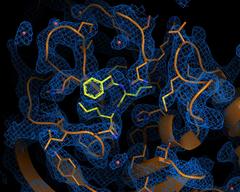
he coronavirus disease (COVID-19) caused by SARS-CoV-2 is creating tremendous human suffering. To date, no effective drug is available to directly treat the disease. In a search for a drug against COVID-19, we have performed a high-throughput X-ray crystallographic screen of two repurposing drug libraries against the SARS-CoV-2 main protease (Mpro), which is essential for viral replication. In contrast to commonly applied X-ray fragment screening experiments with molecules of low complexity, our screen tested already approved drugs and drugs in clinical trials. From the three-dimensional protein structures, we identified 37 compounds that bind to Mpro. In subsequent cell-based viral reduction assays, one peptidomimetic and six non-peptidic compounds showed antiviral activity at non-toxic concentrations. We identified two allosteric binding sites representing attractive targets for drug development against SARS-CoV-2.

Science 02 Apr 2021: eabf7945. https://science.sciencemag.org/lookup/doi/10.1126/science.abf7945

Sebastian Günther et al.

Synchronous RNA conformational changes trigger ordered phase transitions in crystals

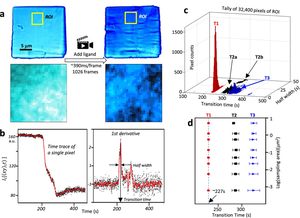
Time-resolved studies of biomacromolecular crystals have been limited to systems involving only minute conformational changes within the same lattice. Ligand-induced changes greater than several angstroms, however, are likely to result in solid-solid phase transitions, which require a detailed understanding of the mechanistic interplay between conformational and lattice transitions. Here we report the synchronous behavior of the adenine riboswitch aptamer RNA in crystal during ligand-triggered isothermal phase transitions. Direct visualization using polarized video microscopy and atomic force microscopy shows that the RNA molecules undergo cooperative rearrangements that maintain lattice order, whose cell parameters change distinctly as a function of time. The bulk lattice order throughout the transition is further supported by time-resolved diffraction data from crystals using an X-ray free electron laser. The synchronous molecular rearrangements in crystal provide the physical basis for studying large conformational changes using time-resolved crystallography and micro/nanocrystals.

Saminathan Ramakrishnan, Jason R. Stagno, Chelsie E. Conrad, Jienyu Ding, Ping Yu, Yuba R. Bhandari, Yun-Tzai Lee, Gary Pauly, Oleksandr Yefanov, Max O. Wiedorn, Juraj Knoska, Dominik Oberthür, Thomas A. White, Anton Barty, Valerio Mariani, Chufeng Li, Wolfgang Brehm, William F. Heinz, Valentin Magidson, Stephen Lockett, Mark S. Hunter, Sébastien Boutet, Nadia A. Zatsepin, Xiaobing Zuo, Thomas D. Grant, Suraj Pandey, Marius Schmidt, John C. H. Spence, Henry N. Chapman & Yun-Xing Wan

Nat Commun 12, 1762 (2021). https://doi.org/10.1038/s41467-021-21838-5

Active learning of potential-energy surfaces of weakly-bound complexes with regression-tree ensembles

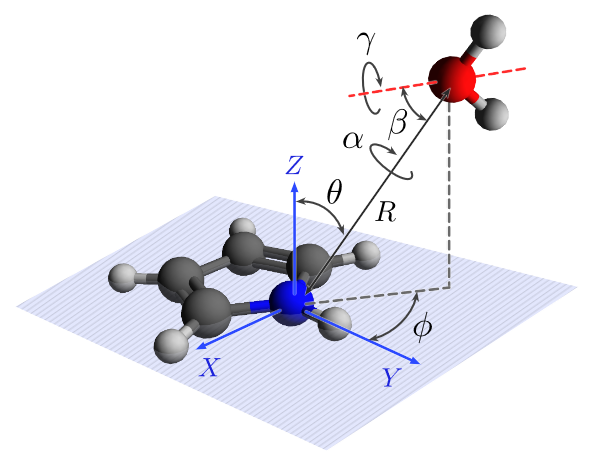
Several pool-based active learning algorithms were employed to model potential energy surfaces (PESs) with a minimum number of electronic structure calculations. Among these algorithms, the class of uncertainty-based algorithms are popular. Their key principle is to query molecular structures corresponding to high uncertainties in their predictions. We empirically show that this strategy is not optimal for nonuniform data distributions as it collects many structures from sparsely sampled regions, which are less important to applications of the PES. We exploit a simple stochastic algorithm to correct for this behavior and implement it using regression trees, which have relatively small computational costs. We show that this algorithm requires around half the data to converge to the same accuracy than the uncertainty-based algorithm query-by-committee. Simulations on a 6D PES of pyrrole(H2O) show that <15000 configurations are enough to build a PES with a generalization error of 16 cm1, whereas the final model with around 50000 configurations has a generalization error of 11 cm1.

https://arxiv.org/abs/2104.00708

Yahya Saleh, Vishnu Sanjay, Armin Iske, Andrey Yachmenev, Jochen Küpper

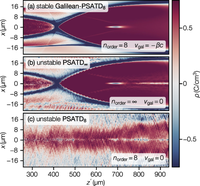
Scalable spectral solver in Galilean coordinates for eliminating the numerical Cherenkov instability in particle-in-cell simulations of streaming plasmas

Discretizing Maxwell's equations in Galilean (comoving) coordinates allows the derivation of a pseudospectral solver that eliminates the numerical Cherenkov instability for electromagnetic particle-in-cell simulations of relativistic plasmas flowing at a uniform velocity. Here we generalize this solver by incorporating spatial derivatives of arbitrary order, thereby enabling efficient parallelization by domain decomposition. This allows scaling of the algorithm to many distributed compute units. We derive the numerical dispersion relation of the algorithm and present a comprehensive theoretical stability analysis. The method is applied to simulations of plasma acceleration in a Lorentz-boosted frame of reference.

Kirchen, Manuel and Lehe, Remi and Jalas, Soeren and Shapoval, Olga and Vay, Jean-Luc and Maier, Andreas R

Optimization and stability of a high-gain harmonic generation seeded oscillator amplifier

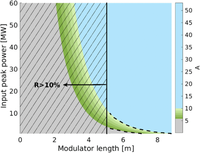
The free-electron laser (FEL) community is interested in taking full advantage of the high-repetition-rates of FELs run by superconducting machines while maintaining the spectral properties achieved with external seeding techniques. Since the feasibility of seed lasers operating at a repetition-rate of MHz and with sufficient energy in a useful wavelength range, such as the ultraviolet (UV) range is challenging, a seeded oscillator-amplifier scheme is proposed instead for generation of fully coherent and high-repetition-rate radiation. The process is triggered by an external seed laser while an optical feedback system feeds the radiation back to the entrance of the modulator where it overlaps with the next electron bunch. Downstream from the feedback system, the electron bunches are then used for harmonic generation. We discuss the optimization of dedicated simulations and we investigate the stability of this scheme with numerical simulations. As a result, we address the control of the reflectivity of the resonator as a key parameter to achieve a stable HGHG seeded radiation. Finally, we show the impact of the power fluctuations in the oscillator on the bunching amplitude with analytical and simulated results. The output FEL radiation wavelengths considered are 4.167 nm and 60 nm.

https://doi.org/10.1103/PhysRevAccelBeams.24.034801

Georgia Paraskaki, Vanessa Grattoni, Tino Lang, Johann Zemella, Bart Faatz, and Wolfgang Hillert