Skip to content

science

Three-dimensional imaging of xylem at cell wall level through near field nano holotomography

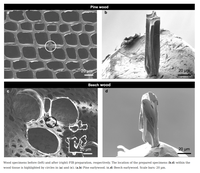
Detailed imaging of the three-dimensionally complex architecture of xylary plants is important for studying biological and mechanical functions of woody plants. Apart from common two-dimensional microscopy, X-ray micro-computed tomography has been established as a three-dimensional (3D) imaging method for studying the hydraulic function of wooden plants. However, this X-ray imaging method can barely reach the resolution needed to see the minute structures (e.g. pit membrane). To complement the xylem structure with 3D views at the nanoscale level, X-ray near-field nano-holotomography (NFH) was applied to analyze the wood species Pinus sylvestris and Fagus sylvatica. The demanded small specimens required focused ion beam (FIB) application. The FIB milling, however, influenced the image quality through gallium implantation on the cell-wall surfaces. The measurements indicated that NFH is appropriate for imaging wood at nanometric resolution. With a 26 nm voxel pitch, the structure of the cell-wall surface in Pinus sylvestris could be visualized in genuine detail. In wood of Fagus sylvatica, the structure of a pit pair, including the pit membrane, between two neighboring fibrous cells could be traced tomographically.

Sci Rep 11, 4574 (2021)

Koddenberg, T., Greving, I., Hagemann, J. et al.

The low-barrier methyl internal rotation in the rotational spectrum of 3-methylphenylacetylene

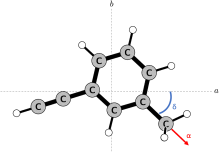
The rotational spectrum of 3-methylphenylacetylene has been recorded in the 2–8 GHz region using a chirped-pulse broadband microwave spectrometer. Torsion-rotation transition splittings are observed from a tunneling motion along the methyl internal rotation axis. The XIAM program was used to characterize the splitting, yielding an internal rotation barrier, , of cm−1. While this barrier is considered low, fits of A-state only transitions yield a quality, rigid-rotor fit, and are compared to the combined A/E fits. Computationally predicted barriers are estimated between 14.4 and 28.9 cm−1.

Journal of Molecular Structure, Volume 1213, 2020

Sérgio R. Domingos, Cristóbal Pérez, Mark D. Marshall, Helen O. Leung, Melanie Schnell

Exploring key ionic interactions for magnesium degradation in simulated body fluid

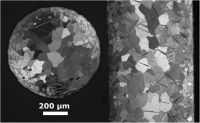
We have studied the degradation of pure magnesium wire in simulated body fluid and its subsets under physiological conditions to enable the prediction of the degradation rate based on the medium's ionic composition. To this end, micro-computed tomography and scanning electron microscopy with energy-dispersive X-ray spectroscopy were used, followed by a tree regression analysis. A non-linear relationship was found between degradation rate and the precipitation of calcium salts. The mean absolute error for predicting the degradation rate was 1.35 mm/yr. This comparatively high value indicates that ionic interactions were exceedingly complex or that an unknown parameter determining the degradation may exist.

Corrosion Science Volume 182, 15 April 2021, 109272

Berit Zeller-Plumhoff, Melissa Gile, Melissa Priebe, Hanna Slominska, Benjamin Boll, BjörnWiese, TimWürger, RegineWillumeit-Römer, Robert Horst Meißner

The New SARS-CoV-2 Strain Shows a Stronger Binding Affinity to ACE2 Due to N501Y Mutation

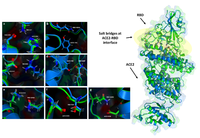
SARS-CoV-2 is a global challenge due to its ability to spread much faster than SARS-CoV, which was attributed to the mutations in the receptor binding domain (RBD). These mutations enhanced the electrostatic interactions. Recently, a new strain was reported in the UK that includes a mutation (N501Y) in the RBD, that possibly increases the infection rate. Using Molecular Dynamics simulations (MD) and Monte Carlo (MC) sampling, we showed that the N501 mutation enhances the electrostatic interactions due to the formation of a strong hydrogen bond between SARS-CoV-2-T500 and ACE2-D355 near the mutation site. In addition, we observed that the electrostatic interactions between the SARS-CoV-2 and ACE2 in the wild type and the mutant are dominated by salt-bridges formed between SARS-CoV-2-K417 and ACE2-D30, SARS-CoV-2-K458, ACE2-E23, and SARS-CoV-2-R403 and ACE2-E37. These interactions contributed more than 40 % of the total binding energies.

https://arxiv.org/abs/2101.01791

Fedaa Ali, Amal Kasry, Muhamed Amin

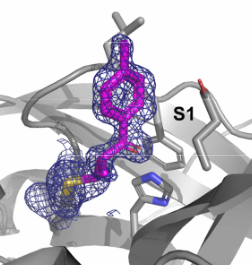
Inhibition of SARS-CoV-2 main protease by allosteric drug-binding

The coronavirus disease (COVID-19) caused by SARS-CoV-2 is creating tremendous health problems and economical challenges for mankind. To date, no effective drug is available to directly treat the disease and prevent virus spreading. In a search for a drug against COVID-19, we have performed a massive X-ray crystallographic screen of two repurposing drug libraries against the SARS-CoV-2 main protease (Mpro), which is essential for the virus replication and, thus, a potent drug target. In contrast to commonly applied X-ray fragment screening experiments with molecules of low complexity, our screen tested already approved drugs and drugs in clinical trials. From the three-dimensional protein structures, we identified 37 compounds binding to Mpro. In subsequent cell-based viral reduction assays, one peptidomimetic and five non-peptidic compounds showed antiviral activity at non-toxic concentrations. We identified two allosteric binding sites representing attractive targets for drug development against SARS-CoV-2.